
Artificial intelligence has been through more hype cycles than perhaps any technology in modern history — and we are very much in the middle of another one. To understand where we are today, it helps to map the current moment against a longer arc of inflated expectations, bitter disappointments, and hard-won breakthroughs.
What Is a Hype Cycle?
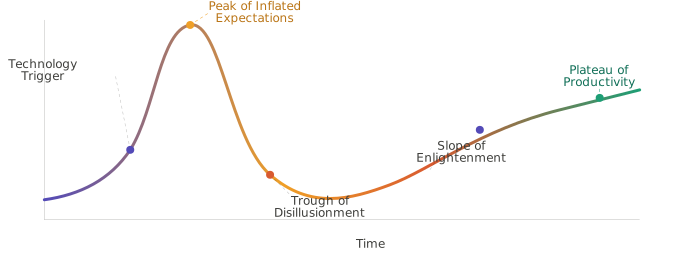
The Gartner Hype Cycle, first introduced in 1995, describes a recurring pattern that nearly every transformative technology follows. It is not a prediction — it is a diagnosis. The five phases are: a Technology Trigger (a breakthrough sparks excitement), a Peak of Inflated Expectations (media and investors pile in with outsized claims), a Trough of Disillusionment (reality bites, funding dries up, skepticism sets in), a Slope of Enlightenment (practitioners figure out what it's actually good for), and finally a Plateau of Productivity (mainstream, durable adoption).
What's remarkable about AI is that it has not experienced one hype cycle — it has experienced several, each separated by years-long winters.
The AI Winters: Hype Cycles Before the Deep Learning Era
Wave 1: The Founding Optimism (1956–1974)
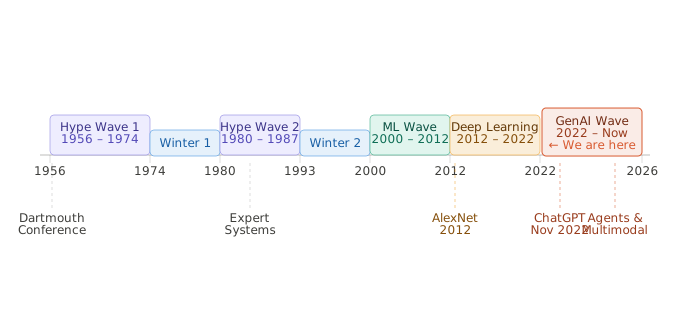
The first AI hype cycle began at the 1956 Dartmouth Conference, where John McCarthy, Marvin Minsky, and others confidently declared that human-level intelligence could be simulated by a machine within a generation. The U.S. and U.K. governments poured money into the field. DARPA funded research expecting breakthroughs that never came. By the early 1970s, when machine translation failed spectacularly and promised chess programs couldn't beat expert players, the UK's Lighthill Report (1973) condemned most AI research as useless. Funding collapsed. The first AI winter had arrived.
Wave 2: Expert Systems and the Second Collapse (1980–1993)
The second wave was more commercially grounded. Expert systems — programs encoding human domain knowledge as rule sets — were genuinely useful in narrow domains. Companies like DEC and Schlumberger deployed them. Japan's Fifth Generation Computer Project stoked a geopolitical race. But the brittleness of rule-based systems, the astronomical cost of maintaining knowledge bases, and the inability to generalize led to another funding implosion in the late 1980s. By 1993, the AI winter had returned.
How AI Compares to Other Hype Cycles
Several patterns emerge from comparing AI to other technology hype cycles. The dot-com bubble (1995–2001) was intense but relatively fast to recover — e-commerce, cloud infrastructure, and search engines proved massively real within a decade. Blockchain hit a sharp, narrow peak and never found a mass-market consumer application beyond speculation. VR/Metaverse collapsed almost as fast as it rose. IoT was mostly boring, slow-burn hype.
AI is unusual in three ways: it has had multiple hype cycles rather than one, each driven by genuinely new capabilities; its recovery periods from winters were measured in decades, not years; and the current GenAI wave has already demonstrably changed how hundreds of millions of people work — suggesting the plateau, when it comes, will be higher than any prior wave.
The Current Wave: Generative AI (2022–Present)
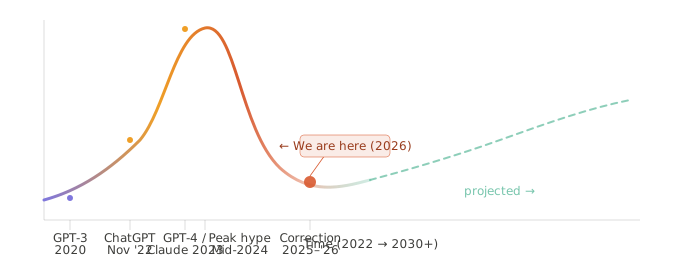
The generative AI wave that began with GPT-3 and exploded with ChatGPT in November 2022 is unlike anything seen before in technology. It reached 100 million users in 2 months — faster than any platform in history. Valuations of AI companies became untethered from revenue. Everyone from Fortune 500 boards to primary school teachers was told AI would either save or destroy them within months.
By 2024–2025, signs of the peak had appeared: AI startup failures began accumulating, enterprise deployments delivered mixed ROI, and the narrative quietly shifted from "AGI is 18 months away" to "how do we actually get this working in production?" This is the trough arriving — not a collapse, but a sobering.
In 2026, we appear to be somewhere in the early descent from the peak, moving into the trough. Unlike the AI winters of the past, however, the trough this time is unlikely to be catastrophic. The technology is genuinely useful in ways the expert systems of the 1980s never were.
A Comparative View: How Different Was Each AI Wave?
The quadrant chart reveals an important truth: the dot-com era is the closest analogy to generative AI. Both were genuinely transformative, yet both were relentlessly overhyped in their first years. The internet did not kill every physical retailer in 1999, but it did reshape commerce, media, and communication over the following two decades. Generative AI's plateau, when reached, will likely tell a similar story.
Why This AI Wave Is Structurally Different
Three structural differences separate the current AI wave from every prior one.
The capability is real and widely accessible. Earlier AI waves were largely laboratory phenomena. Expert systems required a team of knowledge engineers. Deep learning in 2012 was a research curiosity. But GPT-4 and its successors can be accessed by anyone with a browser and produce work that is genuinely useful in a huge range of tasks. The demand is real; only the pace of deployment has been oversold.
The feedback loop is compressed. Prior AI development happened in academic timescales — years between meaningful improvements. The current wave operates on month-level cycles. GPT-4 to GPT-4o to o1 to o3 happened in roughly 18 months. This means the Slope of Enlightenment is arriving faster too.
Infrastructure investment is already sunk. The AI winters of 1974 and 1993 happened partly because governments and corporations could simply stop funding. Today, NVIDIA's data center revenue alone is running at over $100B annually. Cloud providers have committed hundreds of billions in AI infrastructure. The incentive to find a plateau is enormous and the exits are expensive.
Comparing Recovery Patterns Across Technologies
The Anatomy of the Trough We Are Entering
What does disillusionment actually look like in 2025–2026? It does not look like the AI winters of the past. There is no mass defunding. Instead, the signs are subtler and more meaningful:
Measurement pressure. The easy wins — internal chatbots, marketing copy generation, code completion — have been shipped. Now boards are asking: what is the actual ROI? The answer, in many organizations, is murky.
Failure of high-profile bets. Autonomous vehicles remain far from full commercialization despite a decade of enormous investment. AI-driven drug discovery has produced far fewer approved drugs than projected. AI tutoring systems have not transformed education outcomes at scale. These are not failures of AI — they are failures of timetable.
Attention saturation. Consumers who were delighted by ChatGPT in 2022 now treat AI features as table stakes. The novelty premium has expired.
Regulatory friction. The EU AI Act, emerging U.S. executive actions, and liability uncertainty have slowed enterprise deployments in regulated industries.
None of this means AI is going into winter. It means the industry is doing what every maturing technology does: getting real about what the technology can actually do, on what schedule, for whom.
What the Plateau Will Look Like
Every technology that survives the trough emerges not as the thing it was promised to be, but as something more specific, more integrated, and ultimately more durable. The internet did not create a frictionless, borderless global economy — but it did fundamentally restructure commerce, communication, and knowledge access. Smartphones did not make us superhuman — but they did put a computer and a camera in every pocket on earth.
The plateau for AI will look like this: AI embedded invisibly in the tools people already use, accelerating specific tasks — coding, writing, data analysis, medical imaging, logistics optimization — without the constant foreground announcement of its presence. The plateau is not anti-climactic. It is where the compounding returns begin.
Key Lessons from Every Prior Hype Cycle
The pattern, repeated across every wave in this article, points to a few durable lessons for anyone navigating the current moment.
The technology almost always works — but later than promised and in narrower ways than claimed. The winners are rarely the companies most associated with the hype peak, but the ones that build infrastructure and solve specific real problems during the trough. The companies most loudly proclaiming the revolution in 2000 (Pets.com, Webvan) mostly failed; the ones building quietly (Amazon, Google) dominated the plateau.
For individuals, the lesson is equally consistent: the skill that survives every hype cycle is not fluency with the hyped technology itself, but the ability to understand what it can actually do — and apply that understanding to real problems without waiting for the promised revolution or dismissing it as a bubble.
We have seen AI hype cycles before. We have seen them collapse before. What we have not seen before is an AI technology this capable, this accessible, and with this much real-world economic momentum behind it. The trough we are entering is real. So is the plateau waiting on the other side.
license: "Creative Commons Attribution-ShareAlike 4.0 International"